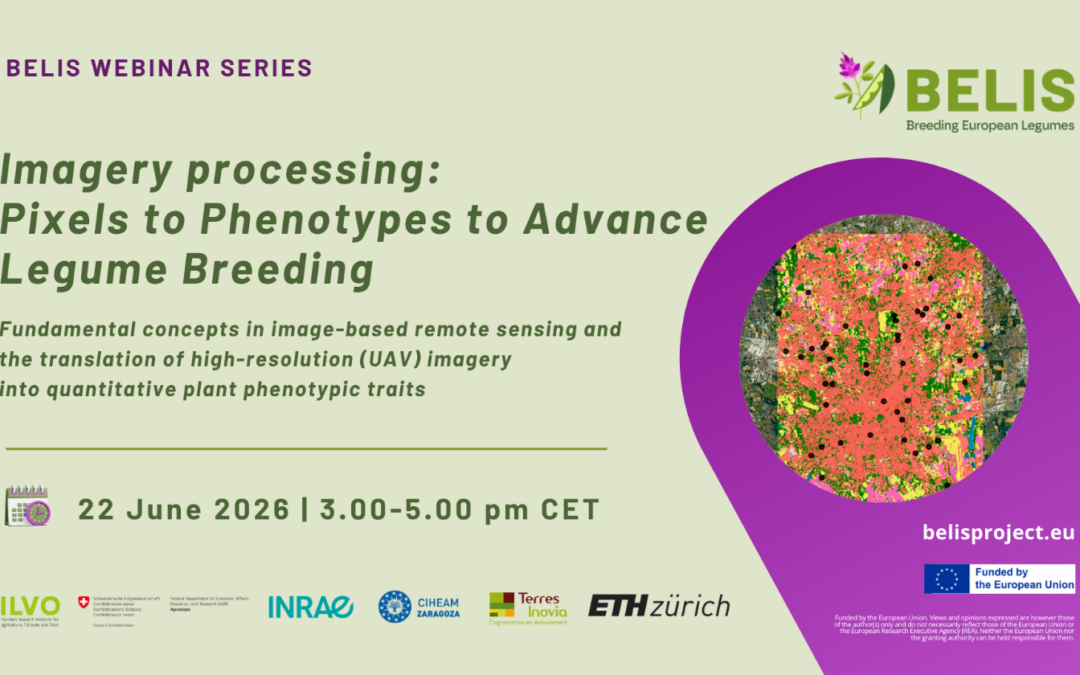
On 22 June 2026, the Horizon Europe BELIS Project (Breeding European Legumes for Increased Sustainability (BELIS)) will be hosting a webinar on “Image processing: Pixels to phenotypes to advance legume breeding”. The Legume Hub community is pleased to share this event with its network.
- Date: 22 June 2026, 15:00 – 17:00 CET
- Application deadline: 18 June 2026
Webinar objectives
This webinar aims to showcase how high-resolution UAV imagery, combined with spectral, spatial, and AI concepts, enables non-destructive, time-efficient extraction of quantitative phenotypic information from crops. Through focused presentations, it will introduce fundamental remote sensing concepts, demonstrate the translation of pixel-level data into plot-level phenotypic traits, and discuss the transformative role of automation and vision-based AI in modern plant phenotyping. The session will also present practical case studies in lucerne, red clover and pea, comparing drone-based predictions with manual phenotyping and evaluating the impact on working conditions and equipment investment.
The webinar will also introduce the European project BELIS – Breeding European Legumes for Increased Sustainability, focusing on 14 legume species, including seven forage legumes (red clover, white clover, annual clover, alfalfa, sainfoin, bird’s-foot trefoil, and vetches) and seven grain legumes (pea, faba bean, soybean, white lupin, lentil, chickpea, and common bean).
The main objectives of BELIS are:
- Developing cost-effective breeding tools
- Improving the economic and regulatory environment for legume breeding
- Ensuring effective innovation transfer through a network of stakeholders, including breeders and seed industry, researchers, registration offices, extension services, feed and food industry, farmers
The webinar will also introduce the stakeholder network being established within the BELIS project, including its goals, activities, benefits of joining, and the steps to become a member.
Target audience
The target audience includes plant breeders, phenotyping researchers, agronomists, remote sensing specialists, and data scientists working in agriculture and plant improvement who are interested in integrating UAV-based imaging and AI into their workflows. The webinar is also particularly relevant for researchers and technicians involved in field trials, crop breeding programmes, and sustainable agriculture projects in the Mediterranean region, as well as for professionals seeking to adopt innovative, non-destructive tools for large-scale phenotypic assessment and yield prediction.