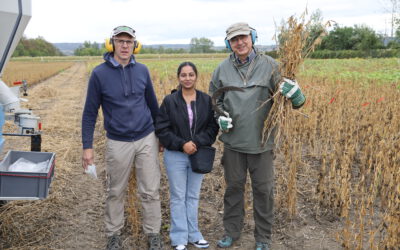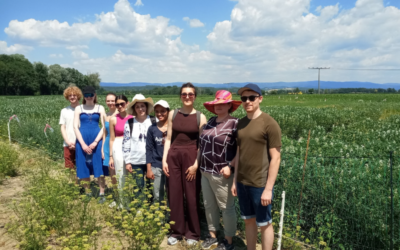
This report sets out the progress that has been made up until August 2024 in Legume Generation in boosting the breeding of pea.
The Pea Innovation Community (PIC) was established to address pressing challenges in pea cultivation while unlocking the crop’s potential for sustainable agriculture and protein diversification. Since its launch, the PIC has made substantial progress in building a coordinated research community, generating genomic and phenotypic resources, and establishing the community infrastructure required for pre-breeding. In particular, we have made progress in:
(i)
community building with active engagement across academic, public-sector, and commercial partners;
(ii)
characterising the Pisum diversity panel, consolidating genomic data and establishing a reference set for trait discovery;
(iii)
delivered multi-trait phenotyping across various environments, generating robust datasets on key traits relevant to climate resilience and yield; and
(iv)
established a pipeline linking phenotypic data with genotypic information, enabling preliminary trait–genotype analyses and preparing the groundwork for marker development, thereby creating new opportunities for integrating pea into both public and private breeding pipelines.
In the next steps, we will focus on expanding and integrating the multi-location trial datasets, advancing trait–genotype association analyses using pangeome approach, and developing new collaborative partnerships to extend the reach of PIC resources. These activities will support the generation of markers and pre-breeding lines for deployment within partner breeding programmes. The collaborative model has fostered new academic–industry partnerships, training opportunities, and international exchanges that will strengthen innovation capacity in legume research beyond this project.
Legume Generation
An introduction to Legume Generation
With this booklet, partners of the Legume Generation consortium want to provide an insight into the background to the Legume Generation project, how it works, and into its approach to boosting the breeding of legumes. The goal of Legume Generation is two-fold: to...
Fascination of Plants Day: Celebrating the vital role of legumes in Europe’s past and future
On 18 May, the global scientific community marks the Fascination of Plants Day, an initiative highlighting the essential role of plants in our lives, from food and feed to environmental sustainability and innovation. EU-funded sister projects Legume Generation and...
Progressing the breeding of clover
This report sets out the progress that the Legume Generation Clover Innovation Community made up until August 2025 in boosting the breeding of clovers (Trifolium repens) and red clover (Trifolium pratense). These are two key forage legumes in agricultural systems.
EU projects to enhance diversity, resilience and competitiveness of legumes — a satellite workshop at ILS5
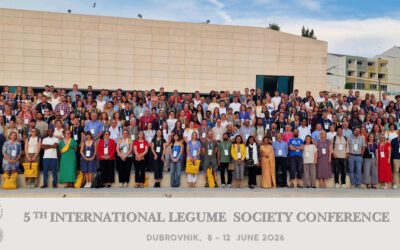
As part of the 5th International Legume Society Conference (ILS5), taking place from 8–12 June 2026 in Dubrovnik (Croatia), a dedicated workshop entitled “EU projects to enhance diversity, resilience and competitiveness of legumes” will be held on Monday, 8 June 2026,...
Legume Generation Open Field Day
The Legume Generation Lentil Innovation Community is pleaseed to invite you to their upcoming Open Field Day Friday, 29 May 2026 at 14:00, at the Rimpertsweiler farm near Lake Constance and organized by the Keyserlingk-Institute. In addition, you are warmly welcome to...
An agenda for public investment in legume plant breeding
The purpose of this position paper is to provide an agenda for the development of European Union Horizon call topics relevant to legume breeding in Horizon Europe. It has four parts:
1. It all starts with a seed: what is plant breeding?
2. Further public investment in legume plant breeding.
3. Priority traits for publicly supported plant breeding.
4. Fostering efficient and focused ‘Horizon’ projects.
Plant breeding is a powerful technology. It is a cornerstone of competitive sustainable farming systems. The seeds we use today incorporate all the improvement plant breeders have made since our crop species were first domesticated, cascaded through the generations. In addition to directly benefiting farmers, the genetic progress in new improved varieties gained by a breeder in Europe is usually freely available to all competing breeders for their own further breeding. This free access fosters innovation and gives most plant genetic improvement a strong public-good character. However, as is typical for public goods, there is under-investment in breeding for most crops due to biological constraints on the revenue from breeding. This is especially so for minor crops such as the grain legumes. Grain legumes in particular are easily reproduced on farms without paying royalties and their minor crop status means that the market for their seed for multiplication by agents is limited. The overall result is sub-optimal investment in legume breeding from both an agricultural and wider societal viewpoint. This market failure applies to all relevant agronomic and quality traits, including crop yield.
Long Night of Research 2026
Long Night of Research 2026 | Lange Nacht der Forschung 2026 Friday, April 24, 202617:00 - 23:00 UFT - Universitäts- und Forschungszentrum TullnKonrad Lorenz Straße 24, 3430 Tulln, Austria How do soybeans manage drought ? Soybean is a food crop delivering high-quality...
Progressing the breeding of phaseolus bean
This report documents the progress that has been made up until August 2024 by Legume Generation to boost the breeding of phaseolus beans.
Our activities are guided by the expectations of the breeders of our innovation community. Our innovation community consists of 20 partners with currently 11 breeding and 13 pre-breeding programmes. By addressing their demands, we will gain improved phaseolus crops that compete better with other crops on farms. Phaseolus bean encompasses several crops which we consider in our work: Common bean (Phaseolus vulgaris L.) as snap (vegetable or French bean) and dry bean. There are two growing forms for each: bush and pole bean each. Common bean is also cultivated in intercropping for feed. The scarlet runner bean (Phaseolus coccineus L.) is a pole bean grown for both snap and dry beans.
Characterisation and breeding of legume crops
The purpose of this paper is to characterise protein crops and to discuss the challenges and opportunities for the genetic improvement of legumes in a changing environment. It relates to the pre-farm gate part of protein crop value chains. We hope to address in particular further public (such as the European Union) and private investors (breeders) and breeders in crop genetic improvement.
Second in-person Legume Generation consortium meeting
On 4 December, the Legume Generation partners had their second in person consortium meeting at the Radboud University in Nijmegen, the Netherlands. The Legume Generation consortium, consisting of 33 partners from 15 countries, runs more than 70 legume breeding and...
Poster presentation at the BIC & NAPIA Biennial Meeting 2025
The Legume Generation's Bean Innovation Community presented a poster at the BIC & NAPIA Biennial Meeting 2025 in Lincoln, Nebraska, USA. The BIC & NAPIA meeting aimed to: To provide a forum on recent research developments and plans for projects in pulse crops...
Legumes in Science and Practice
Call for Papers - Submission deadline: Sunday, 30 November 2025 Agriculture is faced with the challenges of reducing its impact on the environment, adapting to the changing climate, and supporting biodiversity. Dietary change towards flexitarian/plant-based diets also...
The plan for boosting the breeding of clover
The plan for boosting the breeding of phaseolus bean
The plan for boosting the breeding of lentil
The plan to boost the breeding of pea
The plan for boosting the breeding of lupin
The plan for boosting the breeding of soybean
BELIS Stakeholder Day
On 10 September 2025, Johann Vollmann (BOKU) participated in the BELIS Stakeholder Day held in Novi Sad, Serbia. The event gathered researchers and stakeholders from across Europe to discuss the progress and synergies of legume research initiatives, particularly...
Common bean pre-trial of 70 genebank accessions in 2024
Seeds from different accessions of common bean
Donau Soja General Assembly & Networking Event 2025
The Donau Soja Networking Event 2025 took place on 4 September 2025 in Vienna, Austria, and was dedicated to discussing the European protein strategy with more than 100 members and partners from the enitre soybean value chain. A panel discussion with the topic ‘Why we...