
Dissection of genomic regions associated with plant height and flowering time in a diverse panel of common snap bean (Phaseolus vulgaris L.) using GWAS
Lars-Gernot Otto, L. V. Aiyesa, Lyudmyla Malysheva‑Otto, T. Meyer‑Luepken, U. Lohwasser, B. Ruckwied, A. Himmelbach, A. W. Schulthess, J. C. Reif
08.04.2026
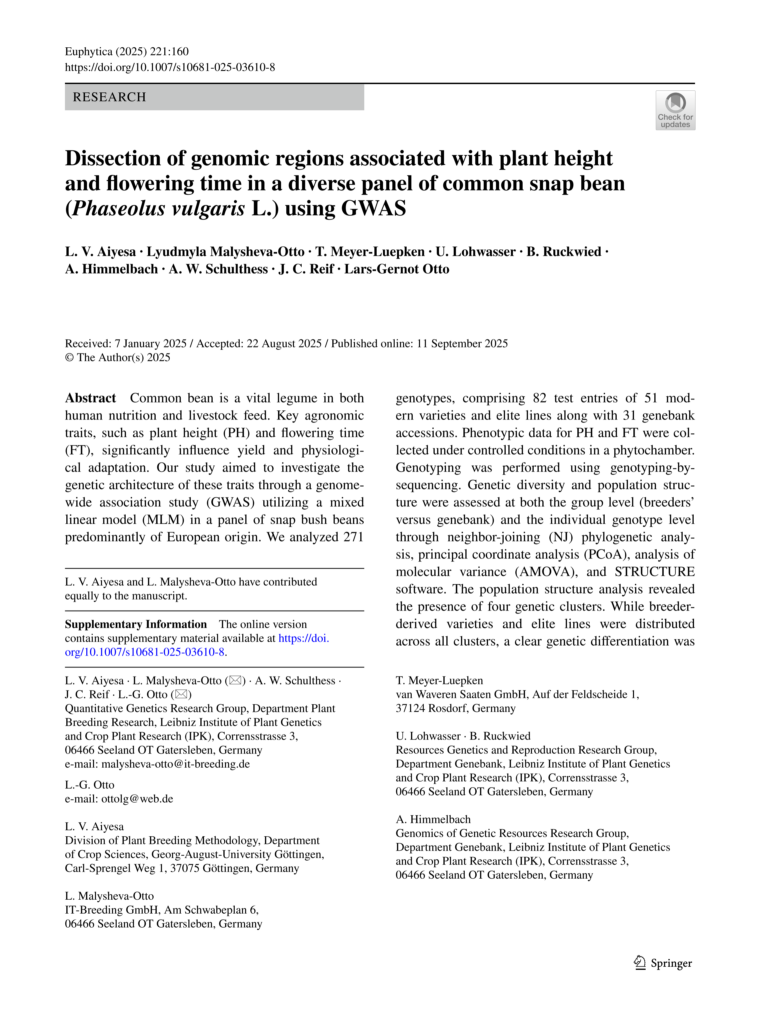
Common bean is a vital legume in both human nutrition and livestock feed. Key agronomic traits, such as plant height (PH) and flowering time (FT), significantly influence yield and physiological adaptation. Our study aimed to investigate the genetic architecture of these traits through a genome-wide association study (GWAS) utilizing a mixed linear model (MLM) in a panel of snap bush beans predominantly of European origin. We analyzed 271 genotypes, comprising 82 test entries of 51 modern varieties and elite lines along with 31 genebank accessions. Phenotypic data for PH and FT were collected under controlled conditions in a phytochamber. Genotyping was performed using genotyping-by-sequencing. Genetic diversity and population structure were assessed at both the group level (breeders’ versus genebank) and the individual genotype level through neighbor-joining (NJ) phylogenetic analysis, principal coordinate analysis (PCoA), analysis of molecular variance (AMOVA), and STRUCTURE software. The population structure analysis revealed the presence of four genetic clusters. While breeder-derived varieties and elite lines were distributed across all clusters, a clear genetic differentiation was observed between breeder and genebank accessions. GWAS identified 25 and 19 significant marker-trait associations (MTAs) for PH and FT, respectively, which were assigned to 12 and 8 quantitative trait loci (QTL). Notably, nine QTL for PH located on chromosomes Pv05, Pv10 and Pv11, and eight QTL for FT on chromosomes Pv04, Pv05, Pv07, Pv10 and Pv11, represent novel findings not previously reported. The QTL with the largest phenotypic effect were identified on chromosomes Pv04 and Pv10, accounting for 15.9% and 5.4% of phenotypic variance for PH and FT, respectively. In conclusion, our study uncovers several novel loci associated with PH and FT providing targets for breeding activities, and offers insights into the population structure differences between breeders´ and genebank bean genotypes.
Downloads
About this article
Lars-Gernot Otto, L. V. Aiyesa, Lyudmyla Malysheva‑Otto, T. Meyer‑Luepken, U. Lohwasser, B. Ruckwied, A. Himmelbach, A. W. Schulthess, J. C. Reif
For matters related to publisher, citation and copyright, please refer to the original article.
The content is solely the responsibility of the authors. No warranties, expressed or implied, are made with respect to the information provided. Information relating to the use of plant protection products (pesticides) must be checked against the product label or other sources of product registration information.
0 Comments