
Template Advanced Artikel: Inter-row cultivation in soybean
Mechanical control of weeds in soybean crops
Svetlana Balešević Tubić, Jegor Miladinović, Vuk Đorđević, Zlatica Miladinov, Marjana Vasiljević
Published in: 2019
Outcome
Inter-row cultivation suppresses weeds between rows and loosens the soil surface. This improves soil aeration, reduces water evaporation, and breaks soil crusts. This has a positive effect on the microorganisms, as well as on the number and activity of nitrogen-fixing bacteria that are found on soybean roots leading to increased biological nitrogen fixation. The overall result is an increase in crop yield and quality.
Applicability
Theme: Crop management
For: All soybean growers
Where: Where soybean is planted
Timing: April/May
Equipment: Cultivator
Follow-up: No follow-up action required
Impact: Reduction of weeds, soil aeration is
improved, soil crust is broken
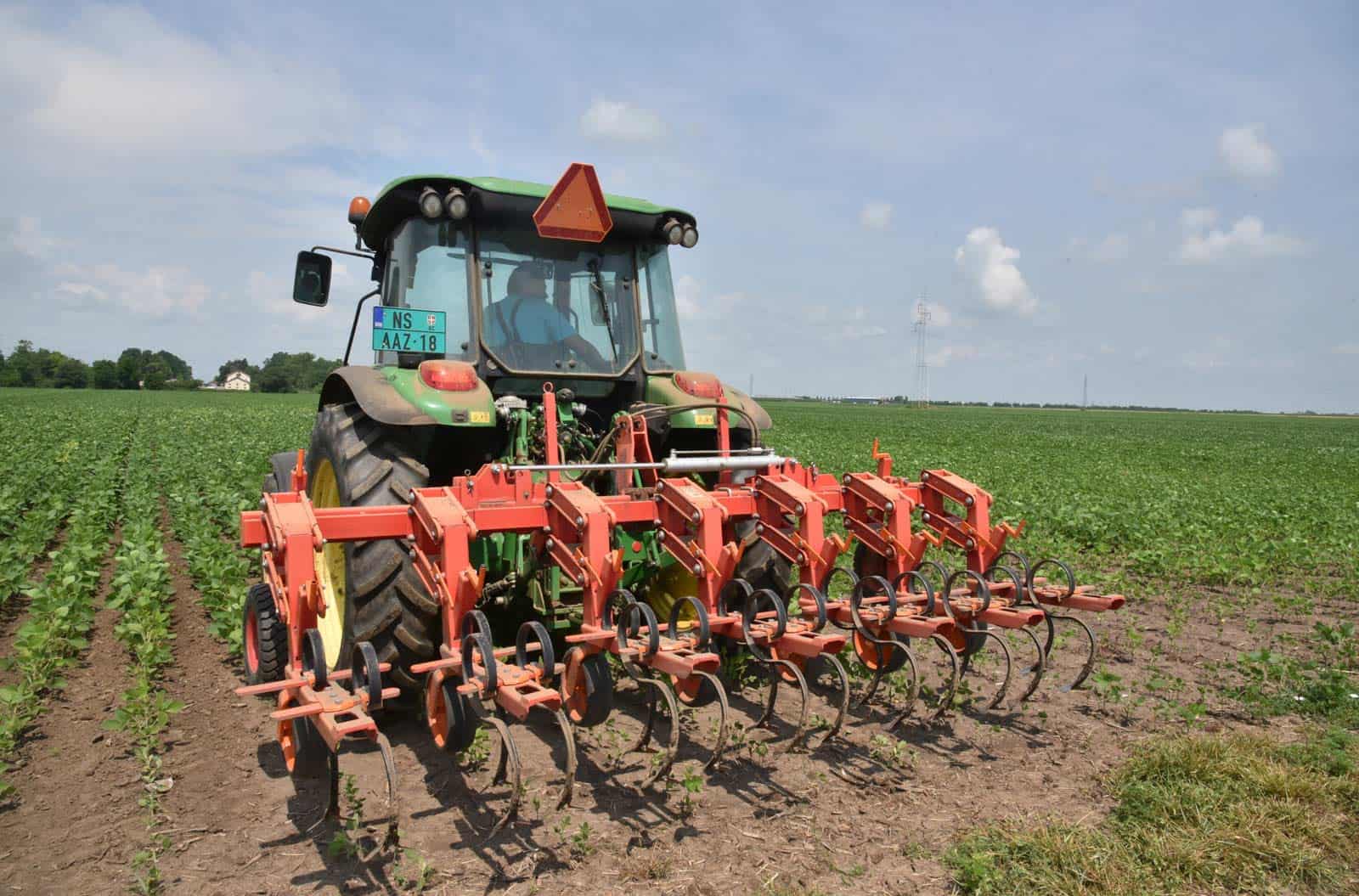
Inter-row cultivator
Attention to detail is essential
There are various options for mechanical interrow weed control. Soil conditions, growth stage of weeds, and the equipment used will determine which practices are well-suited to the soil conditions, selected crop, and site-specific conditions.
A row cultivator tills the soil and uproots weeds between rows. The machine used matches the configuration of the seeding machine. Cultivation is carried out in the same direction and row number as the planting. Optimal speed is about 6 km/h. The speed of the tractor, the depth, and the size of the protective zone between the tines or hoes and the crop vary with the selected crop. There is now a range of cultivating tools such as different harrows, rotary hoes, finger weeders and flame weeders that can be used in combination mounted on row cultivators for mechanical weed control.
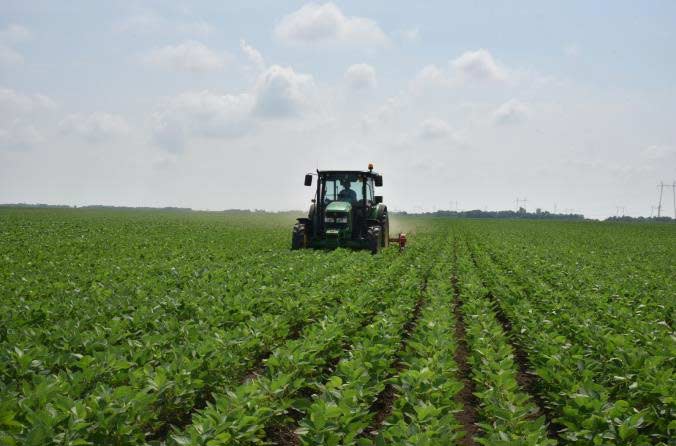
Inter-row cultivator
When to cultivate
Soybean can be inter-row cultivated up to three times during the early growing period (generally in April and May). Cultivation is most effective when the weeds are young. One cultivation at this stage has the largest effect. The earliest opportunity to cultivate is at the first trifoliate leaf stage of the crop. At this time, the individual hoes can go closer to the plants and slightly deeper (5-6 cm), taking care not to cover the young plants with soil.
With second or later cultivations, the protective plant zone must be wider, and cultivation should be shallow (3-4 cm), so that the crop root system is not damaged. The latest opportunity to cultivate is just before canopy closure. This is a relatively easy operation. The hoes must be sharp, properly adjusted to cultivate at the same depth and provide the required protection zone of 7.5 to 10 cm from the plants.
Impact on yield
One or two inter-row cultivations increase soybean yield by up to 275 kg per ha. This is also confirmed in trials where herbicides were also used established in 2015. One inter-row cultivation increased yield by 5.3%, two by 7.1% and three by 7.3%. The increase was larger in years with lower rainfall.
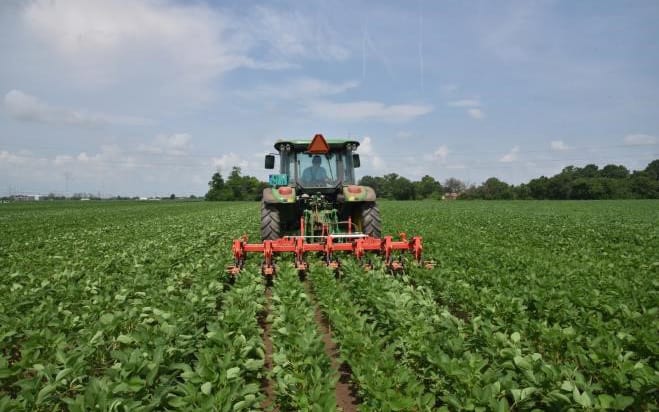
Machinery in action
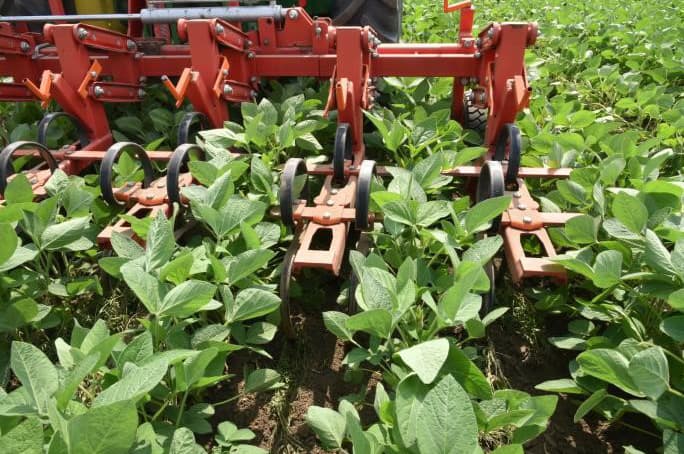
Second cultivation, cultivator in action
One inter-row cultivation increased yield by 5.3%, two by 7.1% and three by 7.3%. The increase was larger in years with lower rainfall.
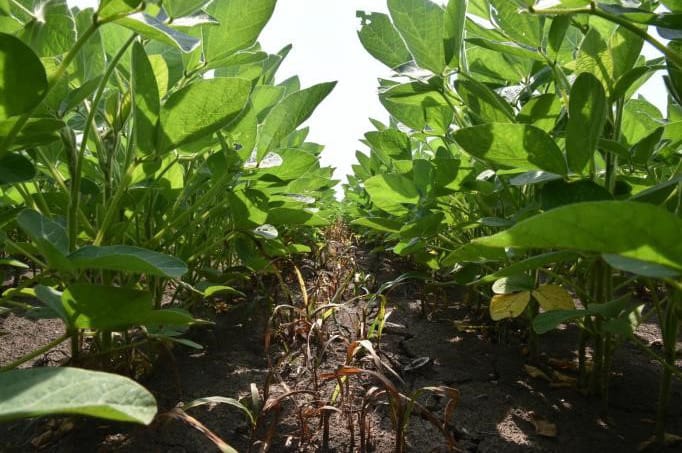
Weed presence before inter-row cultivation
Row width is an important consideration
Row spacing that is too wide or too narrow can affect yield through increased adverse competition for nutrients, water, light, etc. Using relatively narrow rows can delay the start of the critical period by increasing the competitiveness of the crop in relation to the weeds. Many trials have examined the effect of spacing between
row and between plants within the row.
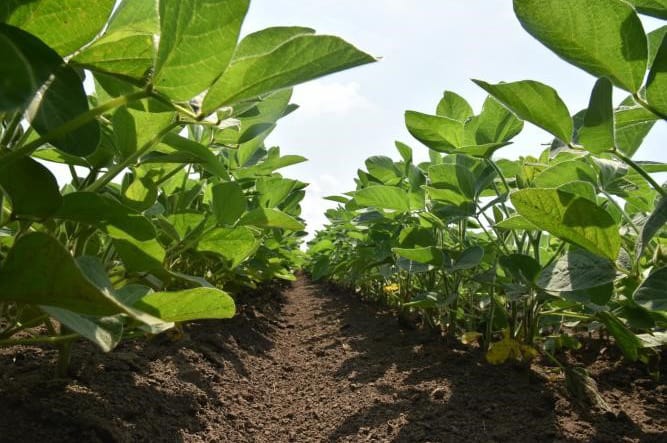
Inter-row spacing after inter-row cultivation
The results show that the best row spacing is 45 or 50 cm, both in terms of available machinery and from the point of view of inter-row cultivation and weed control. In comparison to 70 cm, row spacing of 50 cm helps to stabilize weed flora in soybean production.
Effect on biological activity
Heavy soils are vulnerable to anaerobic conditions. Inter-row cultivation has a positive effect on the microorganisms as well as on the number and activity of nitrogen-fixing bacteria that are found on soybean roots. According to cultivation aerates the soil, which is important for nitrogen fixation as well as for the activity of other soil microorganisms that decompose organic matter. Inter-row cultivation reduces evaporation and preserves soil moisture, which increases microorganism activity and the fixation of atmospheric nitrogen. This ultimately increases soybean yield.
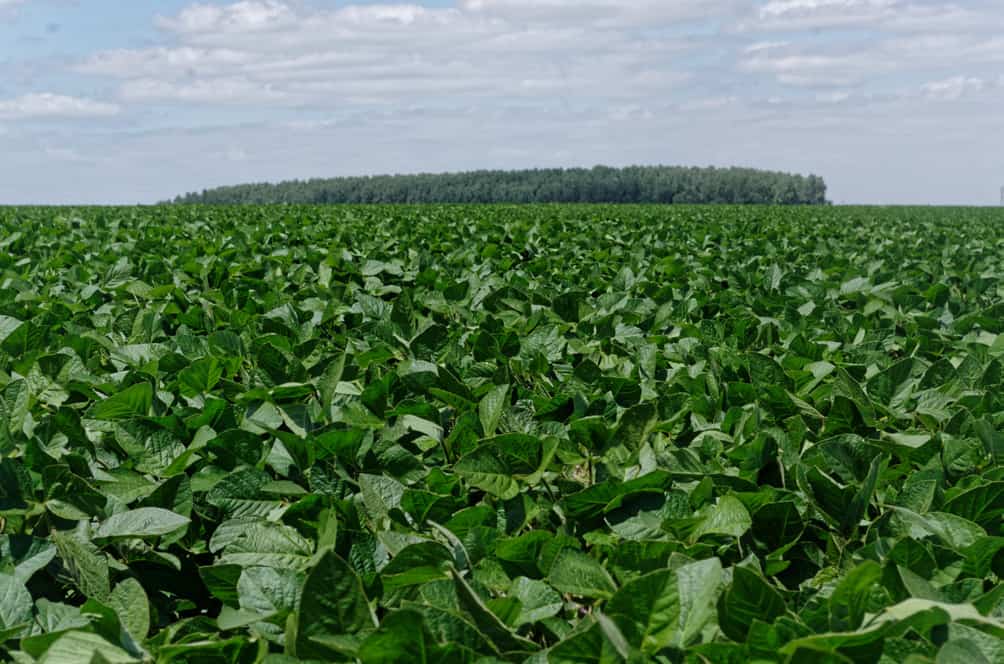
A fully functioning soybean crop canopy following successful weed control. Photograph: Donal Murphy-Bokern
Key practice points
Timing
• April/May
Frequency
• Two or three times during soybean growing period
Benefits
• Reduction of weeds in the inter-row space
• Evaporation is reduced, soil moisture is conserved promoted
• Activity of microorganisms is increased
• Plant growth and vigour increased
Further information
The Legume Hub channel on Youtube provides helpful video resources. Demonstration of machinery for mechanical weeding:
https://www.youtube.com/watch?v=FJZ8VEKizhc&t=14s
Downloads
Images
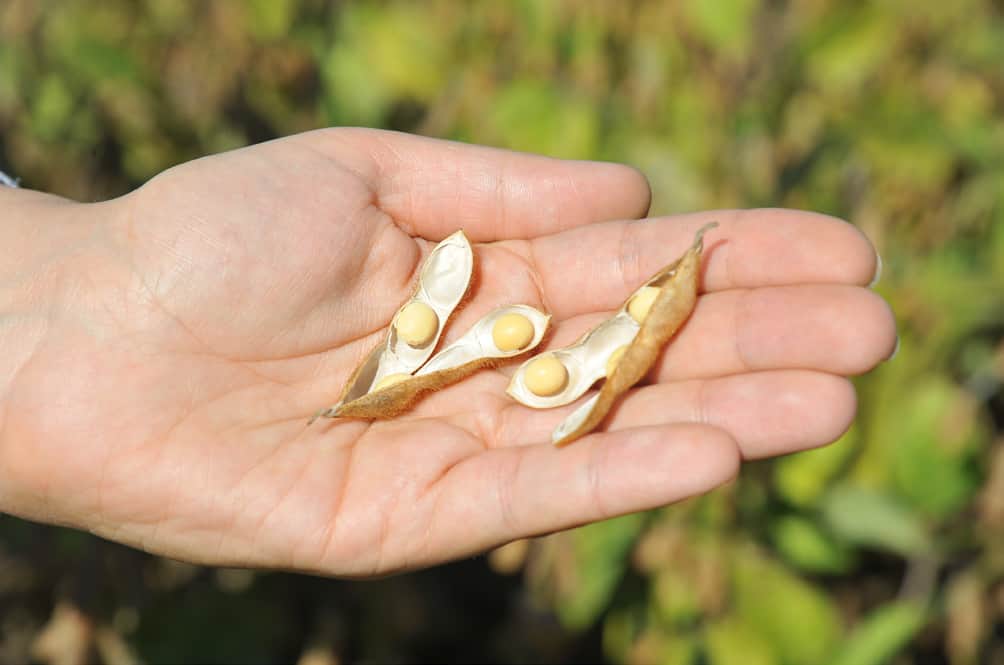
A fully functioning soybean crop canopy following successful weed control. Photograph: Donal Murphy-Bokern
A fully functioning soybean crop canopy following successful weed control. Photograph: Donal Murphy-Bokern
Sources
Information presented in this practice note
results from research carried out by Institute of
Field and Vegetable Crops Novi Sad, Serbia.
Crnobarac, j., Đukić V., Marinković (2011).
Soybean cultural practices. In: Miladinović, J.,
Hristić., M. and Vidić, M. Soybean. Institute of
Field and Vegetable Crops, Novi Sad. pp. 276-
311. (Book chapter).
Balešević-Tubić, S., Miladinović, J., Đukić V.,
Vidić, M., lončarević, V., Ilić, A., Kostć, M.,
Đorđević, V., Nikolić, Z., Jasnić S., Radoslav,
Sekulić., Kereši, T., Pavkov, I., Vujaković, M.,
Dozet, G. (2014) Semenarstvo soje – Novi Sad,
Institut za ratarstvo i povrtarstvo, Novi Sad.
Đorđević, V., Malidža, G., Vidić, M., Milovac, Ž.,
Šeremešić, S. (2015) Priručnik za gajenje soje,
Danube Soya – Novi Sad, Dunav soja regionalni
centar
Miladinović, J. (2012) Vodič za organsku
proizvodnju soje – Beograd, GIZ – Nemačka
organizacija za internacionalnu saradnju GmbH;
Novi Sad – Institut za ratartstvo i povrtarstvo.
Đukić, V., Miladinov, Z., Dozet, G., Balešević-
Tubić, S., Miladinović, J., Ranđelović, P., Ćeran,
M., (2019) Međuredna kultivacija – agrotehnička
mera za povećanje prinosa. Journal of
Agricultural Sciences Vol. 64, No. 1
About this practice note and Legumes Translated
Authors: Svetlana Balešević Tubić, Jegor Miladinović, Vuk Đorđević, Zlatica Miladinov, Marjana Vasiljević
Publisher: Institute of Field and Vegetable Crops Novi Sad (IFVCNS), Serbia
Production: Donau Soja
Permalink: https://www.zenodo.org/record/3742298
Copyright: © All rights reserved. Reproduction and dissemination is permitted for non-commercial purposes provided the authors and source are fully acknowledged. This practice note was prepared within the Legumes Translated project funded by the European Union through Horizon 2020, Project Grant Number 817634.
Citation: Balešević Tubić, S., Miladinović, J., Đorđević, V., Miladinov, Z., Vasiljević, M. (2019) Inter-row cultivation.
Practice Note. Legumes Translated Practice Note 2. www.legumestranslated.eu
Photographs: IFVCNS Soybean Department. Exceptions are marked accordingly.
The content is solely the responsibility of the authors. No warranties, expressed or implied, are made with respect to the information provided. Information relating to the use of plant protection products (pesticides) must be checked against the product label or other sources of product registration information.